A core idea of Salesforce is to have “a single source of truth.” We want all our key touchpoints with a customer in one system, so employees across different departments all see the same information. We don’t want key notes getting lost!
If that’s the goal, what effect do duplicates have on a system?
Duplicates undermine the entire premise of a single source of truth.
On one record for a contact, we see her phone number and email. But on a duplicate record, we see a note that says “She loves our product but NEVER CALL HER BEFORE LUNCHTIME!”
Clearly that warning doesn’t work if it’s not on the same page as her phone number.

Duplicates aren’t just a problem because you can miss key data. They also spread bad data. Any reports, formulas, and summaries of your data will produce bad results when duplicates are in the mix.
And your team will quickly stop using fields like “last touchpoint,” because they’ll give misleading information.
Users need to trust their data
Like any relationship, trust is the foundation. As duplicates erode trust, the whole structure gets shakier. But this is avoidable.
So how do we fix it?
Salesforce has a free, built-in duplicate detection tool. It’s better than nothing, but it’s primitive. It’s very black and white, and that’s not the real world. Real potential duplicates come in shades of grey. We need more nuance.
My favorite duplicate tool is Duplicate Check. What I love is that different rules can give different levels of confidence that a pair is a true duplicate.
So you could have a rule that pairs with 100% confidence are merged automatically, while pairs with 75% confidence go to a report for manual review.
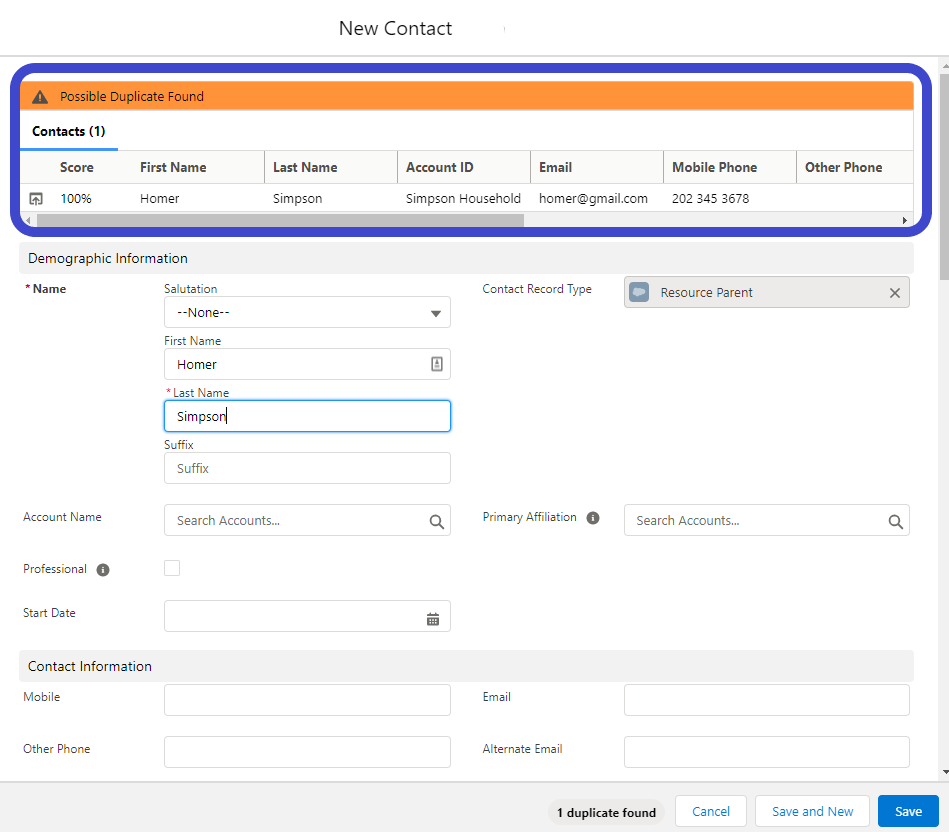
Users tell me they love seeing potential duplicates in real time when they create a new contact. A friendly prompt pops up and prevents trouble before it starts.
For the annual investment most firms make in Salesforce, a duplicate-checking tool is an absolute no-brainer for return on investment.